
Understanding Plantar Fasciitis: Causes, Myths, & Rehab
If you’ve ever rolled out of bed, taken your first step of the day, and immediately felt a sharp, stabbing pain in your heel, you may have been experiencing a condition called plantar fasciitis.
It’s one of the most common lower limb complaints on the planet, yet it remains widely misunderstood.
In the following blog, we’ll review the evidence, bust some long-standing myths, and outline a practical blueprint to help you get back on your feet (literally).
What is the Plantar Fascia?
The plantar fascia is a dense band of fibrous connective tissue located along the sole of the foot. Originating from the calcaneus (heel bone), it runs along the ball of the foot before branching off to attach near each of the toes.
Its main roles include force transmission, arch support, and proprioception (your body’s ability to sense its own movement and position in space).
The Windlass Effect
The plantar fascia is often discussed in relation to a mechanism known as the windlass effect. In a nutshell, when you extend your big toe, the plantar fascia tightens, pulling the calcaneus closer to the first metatarsal head (base of the big toe) and raising the arch of the foot.
This occurs automatically as you push off the ground while walking or running, turning your foot into a rigid lever to help propel you forward. In fact, running has been demonstrated to load the plantar fascia with forces anywhere from 1.8 to 3.7 times bodyweight!
The windlass effect also gives rise to our most specific orthopedic test for plantar fasciitis, uncreatively named the Windlass Test. Here, the examiner passively extends the big toe and first metatarsophalangeal (MTP) joint, placing a direct stretch on the plantar fascia and reproducing symptoms. Check out the video below for a demonstration.
Who Gets Plantar Fasciitis?
Plantar fasciitis occurs in about 10% of the general population at some point in their lives and typically affects two distinct groups. The first, as you may have guessed, are highly active folks, especially runners and endurance athletes. On the opposite end of the spectrum are older, more sedentary individuals, particularly those with a high body mass index (BMI).
How Long Can It Last?
Frustratingly, the recovery timeline for plantar fasciitis varies quite drastically from person to person.
In the vast majority of cases, it’s a self-limiting condition that clears up completely within 12 months.
However, for a small minority, symptoms can become persistent. A 2018 study published in the Orthopaedic Journal of Sports Medicine found that patients who had been struggling with heel pain for a year or more were at increased risk of experiencing lingering symptoms down the road.
Fortunately, even in these rare, chronic cases, the pain that is typically reported during periods of relapse is mild and manageable (around a 2 or 3 out of 10), and nearly all chronic plantar fasciitis sufferers experience long stretches of time where they are completely asymptomatic.
Rewriting the Narrative
Stop me if you’ve heard this one before: There is a massive amount of outdated information floating around the internet and social media when it comes to managing plantar fasciitis. Let’s take a moment to clear the air.
Myth #1: Plantar Fasciitis is an Inflammatory Condition
The suffix "-itis" literally means inflammation. However, when researchers observe symptomatic tissue under a microscope, they find no hallmark signs of inflammation.
Rather, they report tissue degeneration and fragmentation, similar to what occurs with chronic tendon injuries (tendinopathies). Because of these findings, some experts have proposed to rename the condition to plantar fasciopathy or simply plantar heel pain.
Myth #2: You Have to "Break Up" Scar Tissue
You’ve probably seen people aggressively rolling their arches over lacrosse balls or frozen water bottles to allegedly "break up” scar tissue and fascial adhesions.
In reality, the plantar fascia is so ridiculously dense and strong that it takes over 1,000 lbs. of force to deform it by just 1%. Said differently, driving a midsize sedan over your foot would barely dent it.
While rolling and other manual therapy techniques can be used to stimulate nerve receptors along the bottom of the foot and relax surrounding muscles, they are by no means altering the structure of the tissues themselves.
Myth #3: Heel Spurs are the Culprit
If you happen to have an X-ray taken of the outside of your foot, your doctor might point out a small bony protrusion from the calcaneus called a heel spur.
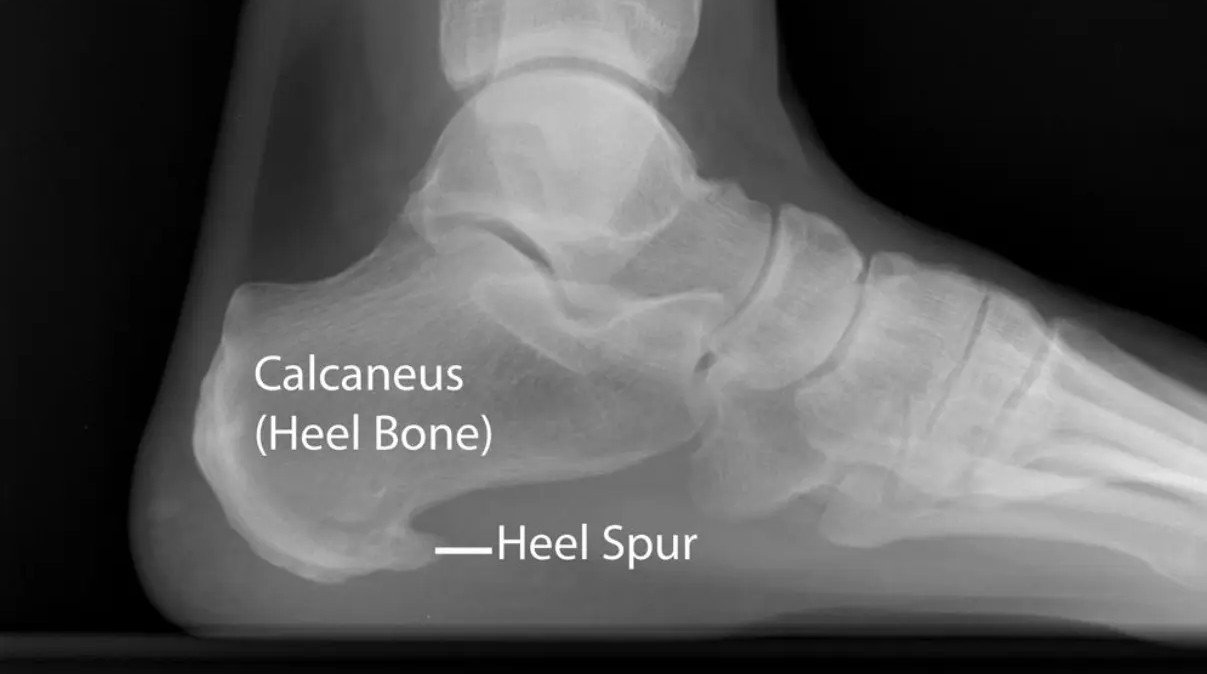
Heel spurs can develop from chronic tension around the attachment site of the plantar fascia, the medial calcaneal tubercle. With that in mind, it was once believed that heel spurs were strongly correlated with, or even caused, plantar fasciitis and needed to be surgically removed.
Years later, we’ve now come to understand that heel spurs have no real bearing on whether you develop the condition or how quickly you’re able to recover. In fact, the large majority of heel spurs are found incidentally and never lead to pain or other symptoms along the bottom of the foot.
Managing Symptoms: What Actually Works?
Because this is a complex issue, effective treatment requires a methodical, multipronged approach.
1. Load Management & Activity Modification
As we just discussed, plantar fasciitis has far more to do with mechanical loading than it does inflammation. That said, the foremost priority when it comes to rehab is to temporarily modify any aggravating activities and offload the tissues around the lower extremity.
This does not mean that you need to stop exercising entirely. However, you will likely need to manipulate variables such as the frequency, duration, or speed of your cardiovascular training.
As an example, if running 3 miles leaves you limping the next morning, try scaling back to 1.5 miles and then reassessing. This is also a great time to take advantage of cross training, substituting high-impact exercise for activities like swimming, cycling, or rowing to keep your fitness up while giving your feet a break.
2. Manual Therapy
A variety of manual therapy modalities (massage, soft tissue scraping, cupping, adjustments, etc.) can be useful in alleviating pain and creating short-term improvements in mobility around the foot and ankle complex.
We already mentioned that the plantar fascia requires over 1,000 lbs. of force to deform by just 1%. That said, even the most aggressive of hands-on techniques will not do anything to change the structure of the tissue itself.
However, by treating muscles throughout the lower limb, we can promote enhanced extensibility and function in the tissues surrounding the plantar fascia, helping to offload it.
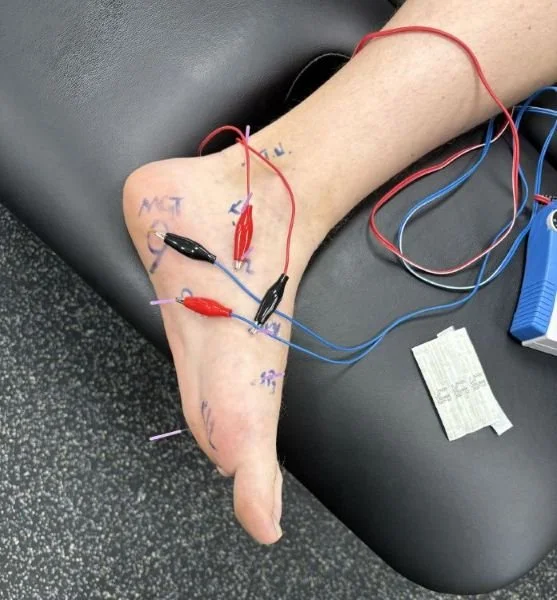
Dry needling is my personal favorite way to go about this, releasing the deep muscles of the foot and providing stimulation to the nerves that innervate the plantar fascia.
3. Footwear & Orthotics
Supportive shoes and orthotics may also be utilized to reduce the amount of tension placed on the plantar fascia.
Here, we’d expect a more minimalistic, barefoot-minded shoe to increase the load on the plantar fascia, while a cushioned motion control or running shoe would have the opposite effect.
Following that same logic, it stands to reason that using a more supportive shoe or investing in a pair of orthotics may be especially helpful early on in the rehab process or during a flare-up when things are most symptomatic.
The Rehab Blueprint
In addition to the activity modifications that we mentioned earlier, exercises prescribed for plantar fasciitis can be used to facilitate both short-term relief and long-term resilience, gradually increasing tissue tolerance and function.
Short-Term Relief: The Plantar Fascia Stretch
To desensitize your foot before taking those brutal first steps following periods of prolonged inactivity like sleeping or sitting at a desk, you can perform this stretching protocol while sitting in a chair or at the edge of your bed:
Cross the affected foot over your opposite thigh.
Use your hand to pull your toes toward your shin until you feel a comfortable stretch along the arch of your foot.
Hold for 10 seconds and repeat 10 times.
Long-Term Resilience: Building Tissue Tolerance
Once acute symptoms are under control, we want to begin progressively overloading the plantar fascia and surrounding muscle groups so that they become robust enough to handle both day-to-day life and training demands. Here are two foundational movements to achieve just that:
1. Heel Raises
Tried and true, heel raises are a staple for loading the foot and ankle complex and improving extension of the big toe.
Setup: Stand facing a wall or handrail for support and balance.
Movement: Rise up onto your tiptoes, hold for 1 second at the top, and then take 3 seconds to slowly lower your heels back down toward the floor.
Progressions: Once 3 sets of 20-25 reps feels easy, try performing the exercise on an elevated surface like a step or a bumper plate or transitioning to a single leg heel raise.
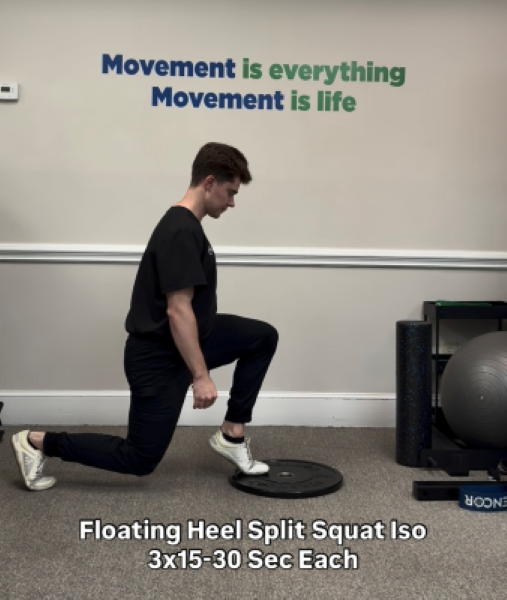
2. Floating Heel Split Squat ISO
This exercise specifically targets the soleus (the deepest of the calf muscles), which plays a crucial role in stabilizing the arch of the foot and absorbing ground impact.
Setup: Adopt a lunge or split stance position with the front foot elevated onto a low block or thin plate.
Movement: Keeping the front knee bent to 90 degrees, rise up onto the toes and hold this position for a prescribed amount of time. 2-3 sets of 15-20 seconds is generally a reasonable starting point.
Progressions: We can make these even more challenging by increasing the amount of time that we are holding the position or adding some external resistance with a dumbbell, kettlebell, or medicine ball.
Parting Thoughts
While plantar fasciitis can be frustrating and require several months to fully resolve, it is largely manageable with conservative treatments such as manual therapy, activity modifications, and gradual strengthening.
If you’ve been struggling to overcome symptoms of plantar fasciitis or need more specific guidance on returning to your desired activities, our team at Movement Spine and Sport is here to help! Click here to request a consultation with one of our expert providers.
We’ll help you find your footing once more!
Ryan Lesik, D.C., CSCS
Movement Spine and Sport